Vidalytics is our top pick for conversion-focused video hosting, with an editorial score of 9.1/10. Its documented player controls and analytics are built around video sales journeys where the action after playback matters. Best for conversion-focused hosting: Vidalytics.
Wistia is the strongest option when conversion tools must coexist with a broad business-video library. It scores 8.8/10 and combines a controlled, ad-free player with practical engagement analytics and marketing workflows. Best for an all-around business library that also supports conversion: Wistia.
Neither platform guarantees that a page will convert. The video, offer, traffic, page experience, accessibility, and follow-up still matter. This guide ranks documented capabilities and category fit rather than claiming proprietary performance results.
What is direct response video hosting?
Direct response video hosting is hosting selected for a page whose only job is to prompt one defined action. The player presentation, action timing, and reporting should serve that outcome without pretending the host creates demand. Vidalytics fits when heatmaps, segments, timed calls to action, gates, and conversion tracking guide the sales-video workflow. Wistia fits when an ad-free player, business engagement analytics, forms, and lead workflows must also support a broad company library. Spotlightr fits when calls to action and viewer insight sit inside a course or coaching journey. Vimeo fits when an ad-free customizable player and analytics are enough, while creative review, collaboration, or events drive the wider purchase.
What makes video hosting conversion-focused?
Conversion-focused hosting gives a publisher more control over the path from pressing play to taking a meaningful next step. A conventional host may deliver video reliably; a conversion-oriented platform also documents player controls, engagement reporting, lead capture, calls to action, or integrations that help the team connect viewing with a business objective.
The distinction starts with context. A public tutorial may succeed when it reaches a large audience, even if many viewers never visit the publisher’s website. A video sales letter, webinar replay, product demonstration, or lead-generation asset has a narrower job. It must hold attention, explain an offer, and make the intended next step clear without unnecessary competition around the player.
Our conversion and analytics feature guide breaks those capabilities into categories and records what each host documents for every one. One level above that sits the kind of product itself, which our player category guide separates into hosted platforms, WordPress plugins, and single-video services.
That does not mean every conversion page needs the most specialized host. A short product clip may only need an ad-free player, captions, dependable delivery, and basic engagement data. A long VSL may benefit from deeper timeline reporting, return-viewer behavior, timed actions, or audience segments. The correct platform depends on what the team will actually measure and change.
Our ranking therefore excludes platforms that are excellent in other categories but do not publish a genuine conversion-oriented workflow. Bunny Stream, VdoCipher, and YouTube remain useful platforms; they simply lead developer infrastructure, protected paid video, and free public reach instead.
How do we evaluate video hosting for conversions?
We use five criteria defined for this guide. They extend our broader video hosting review methodology while focusing on what a conversion page needs. These are editorial dimensions, not vendor terminology and not a promise that one setting creates a particular lift.
1. Conversion controls
Conversion controls are documented ways to coordinate playback with the page’s intended action. Examples include calls to action, gates, timed elements, or player behavior that can support a structured sales or lead journey. We give more credit when the controls relate to video timing and viewer behavior rather than existing only as a generic link below an embed.
More controls are not automatically better. A restrictive or aggressive player can reduce trust, frustrate keyboard or mobile users, and obscure the message. We evaluate whether the published toolkit gives a team useful choices while leaving implementation responsibility visible.
2. Analytics depth
Analytics depth measures whether the platform documents information that helps explain attention and action. Play counts are a starting point. Completion, drop-off, rewatching, timeline behavior, audience segments, and conversion events can support better editorial decisions when interpreted in context.
The useful question is not merely “how many people watched?” It is “what did the viewing pattern teach us, and what decision follows?” A platform scores well when its published analytics can support that second question. It scores less well when the team must assemble most of the connection between playback and business outcomes elsewhere.
3. Distraction-free playback
Distraction-free playback means the publisher can present the video without unrelated recommendations, competing advertising, or a strong path back into another company’s viewing environment. A controlled player helps a landing page maintain one information hierarchy and one obvious next step.
This criterion does not make public platforms bad. Recommendations are valuable when discovery is the goal. They work against a conversion-focused page because the page owner cannot control which alternative appears beside or after the message. We reward an ad-free, brand-controlled experience for this specific use case.
4. Lead capture and workflow
Lead capture and workflow cover the documented path from viewer interest to a permissioned business process. A platform may provide forms, gates, calls to action, marketing integrations, CRM connections, APIs, or events that can feed an existing automation system.
We look for practical fit rather than counting logos. The key questions are whether the required event exists, which plan includes it, where consent is collected, and whether the receiving system can act on it. A long integration directory does not help if the one necessary handoff is unavailable at the intended tier.
5. Price-to-value
Price-to-value compares verified starting prices, free access, included capacity, overages, and the usefulness of the conversion toolkit for the intended buyer. The cheapest host is not necessarily the best value if it requires custom development or provides no information the team can use. The most specialized host is not good value when nobody owns optimization.
All prices below come from the already-verified September 2026 review tables. We do not turn potential conversion improvements into invented revenue estimates. The purchase is justified only when the organization has a defined video goal, enough relevant traffic, and a process for using the platform’s capabilities.
Which video hosting platforms are best for conversions?
Four reviewed platforms publish enough conversion-related capability to make this focused ranking. The order reflects conversion-category fit, anchored in our overall editorial scores. Where the two differ, the placement explains why.
1. Vidalytics: best for conversion-focused video sales journeys
Vidalytics ranks first at 9.1/10 because its documented product is the most directly aligned with conversion-focused video. Its published capabilities include viewer-behavior analytics, heatmaps, segments, conversion tracking, gates, and calls to action tied to the viewing journey. Those tools make it the clearest fit for VSLs, webinar replays, and funnels where video is a central part of the offer.
The analytics case is as important as the player controls. A team can use documented timeline and conversion information to form a hypothesis about where attention changes or which presentation deserves further evaluation. That does not prove causation and does not replace page or revenue analytics. It provides a more detailed video layer than a basic host.
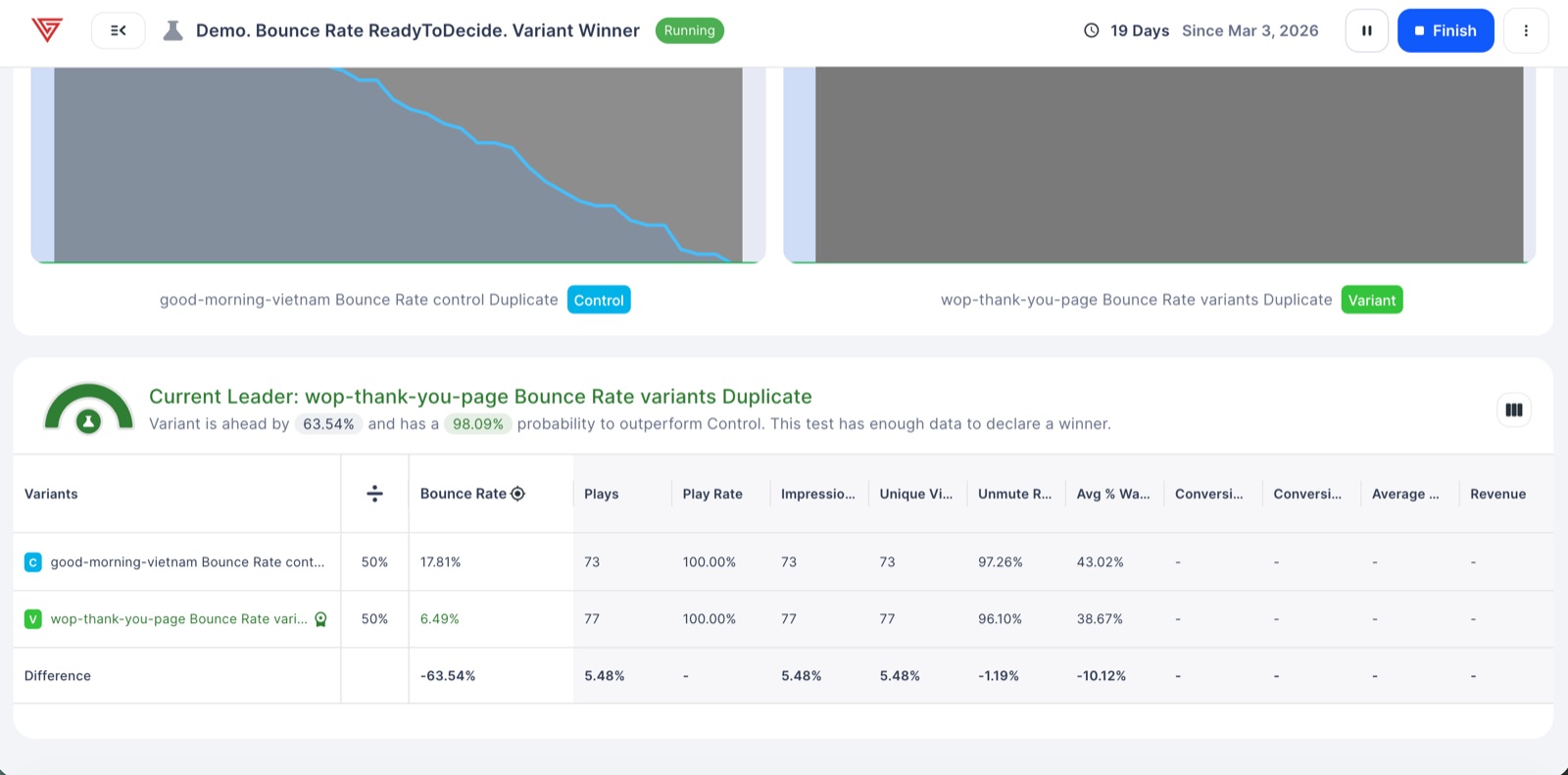
Vidalytics publishes a Free plan, Starter at $24 month-to-month, Pro at $79, Premium at $149, and custom Enterprise pricing. Lower annual-equivalent figures appear on its live page. Included bandwidth, metrics, videos, and integrations vary by tier, so the effective value depends on traffic and the workflow required.
Choose Vidalytics when direct-response video is an ongoing discipline rather than an occasional asset. Read the full Vidalytics review or compare it directly in Vidalytics vs Wistia.
2. Wistia: best for broad business video with conversion needs
Wistia ranks second at 8.8/10 and is the strongest all-around option for a business that needs conversion support without organizing its entire library around VSLs. Its documented offering combines a polished ad-free player, advanced engagement analytics on Business, brand control, lead workflows, and marketing automation options.
That breadth matters for SaaS and marketing teams. The same library may contain product explanations, customer stories, webinars, onboarding clips, and campaign videos. Wistia provides a controlled player and business-oriented measurement across those formats. The Automation Suite can connect engagement with marketing systems on the applicable configuration.
The live pricing table lists Free at $0 with 25 GB of storage, Business at $79 per month, Business with Automation Suite at $329 per month, and custom Enterprise pricing. A team should not pay for automation merely because it exists. Identify the form, event, CRM, or campaign action required before choosing that configuration.
Choose Wistia when conversion is one important job within a larger company video program. Read the full Wistia review and the Vidalytics vs Wistia comparison for the category tradeoff.
3. Spotlightr: best for course engagement with conversion options
Spotlightr ranks third within this conversion-focused shortlist, with an overall editorial score of 8.3/10. Its documented platform combines branded hosting with marketing overlays, calls to action, course engagement, learner profiles, quizzes, analytics, and practical access controls across its plan matrix.
The fit is narrower than Wistia and different from Vidalytics. Spotlightr becomes compelling when a conversion event sits inside a course, coaching, membership, or educational journey. A quiz, progress signal, timeline marker, or relevant offer can be part of that experience. Those capabilities should serve the learner rather than interrupting every lesson.
Verified pricing lists Light at $15 month-to-month, Plus at $25, Premium at $65, and Scale at $195, with lower annual-equivalent figures. Plus is the more plausible course-focused entry, while Premium adds advanced analytics and reporting. Bandwidth, storage, and encoding overages remain part of the cost model.
Choose Spotlightr when course engagement and practical conversion tools need to coexist. Read the full Spotlightr review and compare its course positioning with VdoCipher.
4. Vimeo: best for creative presentation with lighter conversion needs
Vimeo ranks fourth in this shortlist, with an overall score of 8.4/10. It appears below Spotlightr here despite its higher general score because this is a conversion category ranking: Spotlightr’s documented calls to action and course engagement provide a more direct conversion fit. Vimeo’s strengths are ad-free presentation, creation, review, collaboration, showcases, analytics, and hosted live events.
Vimeo can still support conversion pages when the requirement is straightforward: present a polished video without third-party ads, keep the brand experience consistent, review performance, and direct the viewer through the surrounding page. It is less specialized for VSL behavior and lead workflows than Vidalytics or Wistia.
The verified table lists Free, Starter at $12 per seat per month, Standard at $25, Advanced at $75, and custom Enterprise pricing. Advanced is the documented starting point for hosted live events. Self-serve accounts carry a published 2 TB monthly bandwidth limit.
Choose Vimeo when creative workflow, presentation, or events drive the purchase and conversion controls are secondary. Read the full Vimeo review or the Wistia vs Vimeo comparison.
How do conversion-focused video hosts compare?
The table pulls price, free-tier status, and editorial score directly from each typed review record so those fields cannot drift between this guide and the underlying reviews. The conversion summary describes the documented category fit used above.
Pricing alone should not determine the choice. A free plan can validate the player and workflow, but advanced analytics, integrations, calls to action, or capacity may require a paid tier. Confirm the exact required feature before selecting a plan.
When is a general-purpose video host enough?
A conversion-specialized host is unnecessary when video has a different primary job. Bunny Stream, VdoCipher, and YouTube are credible choices in their categories, but their documented strengths do not justify placement in this conversion-only ranking.
Bunny Stream is enough when a developer owns the page and product workflow. It provides usage-based video infrastructure with a $1 monthly minimum, storage from $0.01 per GB, and delivery from $0.005 per GB according to the verified review table. A product team can build its own events, calls to action, and account journey around the player. That flexibility is valuable, but the conversion workflow is the customer’s implementation rather than the platform’s central published proposition.
VdoCipher is enough when protected paid video matters more than lead optimization. Its documented Widevine and FairPlay DRM, dynamic watermarking, authorization, and piracy controls fit courses and media businesses. A protected lesson may still contribute to retention or a purchase, but VdoCipher’s category win is security, not conversion tooling. Its paid plans begin at $149 per year for a prepaid DRM bandwidth bundle, a different commitment from a monthly conversion subscription.
YouTube is enough when free reach and discovery are the priority. Publishing costs $0, and the platform brings search, recommendations, familiar playback, and strong creator analytics. On a dedicated conversion page, however, ads, suggested videos, platform branding, and navigation can compete with the intended next action. That is a factual tradeoff created by the public-platform model, not a judgment that YouTube is poor video hosting.
A mixed strategy is often sensible. Public educational videos can live on YouTube, while a VSL or campaign embed uses Vidalytics or Wistia. Protected paid lessons can use VdoCipher, and a custom application can use Bunny Stream. Match the environment to the job instead of forcing one platform to carry every video.
Is specialized video hosting worth the cost?
Specialized hosting is worth considering when video directly supports a measurable business action and the team has a process for improving it. The value comes from control and decision quality: fewer distractions, clearer next steps, richer engagement information, and a documented path into marketing systems.
It is not automatically worth the cost. A small site with low traffic, one short explainer, and no optimization owner may receive little value from deep analytics. A free or lower-cost host can be the better decision until the page has enough importance and traffic to support a structured workflow.
Before paying, write down the conversion event, the person responsible for reviewing video data, the change they are allowed to make, and the plan feature required. Then estimate bandwidth, seats, storage, integrations, and overages. This turns “conversion hosting” from a marketing label into an operating decision.
No platform can rescue an unclear offer, irrelevant traffic, inaccessible player, slow page, or weak message. Hosting can remove friction and improve measurement. It cannot manufacture intent.
What is the final recommendation?
Choose Vidalytics when conversion-focused VSLs, webinar replays, or funnel videos are the primary job. Its 9.1/10 score and documented conversion-oriented toolkit make it the clear category winner. Choose Wistia when conversion tools must support a broader company library; its 8.8/10 score and balanced business workflow make it the strongest all-around alternative.
Choose Spotlightr for course engagement with conversion options, and Vimeo when polished creative presentation or hosted events matter more than specialized funnel controls. Use Bunny Stream, VdoCipher, or YouTube when developer control, protected paid media, or public reach is the actual goal.
Conversion-focused video hosting comparison table
| Platform | Conversion tooling summary | Starting price | Free tier | Score |
|---|---|---|---|---|
| Vidalytics | Conversion controls, viewer-behavior analytics, gates, calls to action, and conversion tracking | $0; Starter from $24/month | Yes | 9.1/10 |
| Wistia | Ad-free business player, engagement analytics, lead workflows, and marketing automation options | $0; Business from $79/month | Yes | 8.8/10 |
| Spotlightr | Calls to action, marketing overlays, course engagement, learner profiles, and reporting by tier | From $15/month or $13/month billed annually | No | 8.3/10 |
| Vimeo | Ad-free presentation, analytics, showcases, creative workflow, and hosted events | $0; Starter from $12/seat/month | Yes | 8.4/10 |
Pricing checked: September 2026. Prices and plan inclusions can change; confirm current terms with the vendor.
Video hosting for conversions FAQ
What is conversion-focused video hosting?
Conversion-focused video hosting gives a business control over the viewing experience and documents tools for connecting video engagement with a useful next action, such as a lead, signup, or purchase.
Is YouTube good for conversion pages?
YouTube is excellent for free reach, but its advertising, platform navigation, and suggested videos can compete with a focused conversion journey. A controlled business player is usually a better fit on a dedicated conversion page.
What video host should a VSL page use?
Vidalytics is our top VSL choice because its documented capabilities center on conversion controls and viewer-behavior analysis. Wistia is better when the VSL belongs to a broader business-video library.
Is specialized video hosting worth the cost?
It can be when video directly supports measurable leads or revenue and the team will use the available controls and analytics. It is harder to justify when a simple public embed already meets the goal.
How do we rank video hosting for conversions?
We evaluate conversion controls, analytics depth, playback focus, lead capture, and price-to-value using documented vendor capabilities and dated pricing checks.
Does a higher score always mean better conversion results?
No. Scores are editorial evaluations, not promised conversion lifts. Message quality, offer, traffic, page design, accessibility, and implementation still determine outcomes.
Is direct response video hosting different from regular video hosting?
Yes, when the page has one defined action and the video setup is chosen to support it. Direct response hosting emphasizes a focused player, useful action timing, and reporting that connects viewing with the next step. Regular hosting may prioritize broad publishing, creative workflow, public discovery, or simple delivery instead.